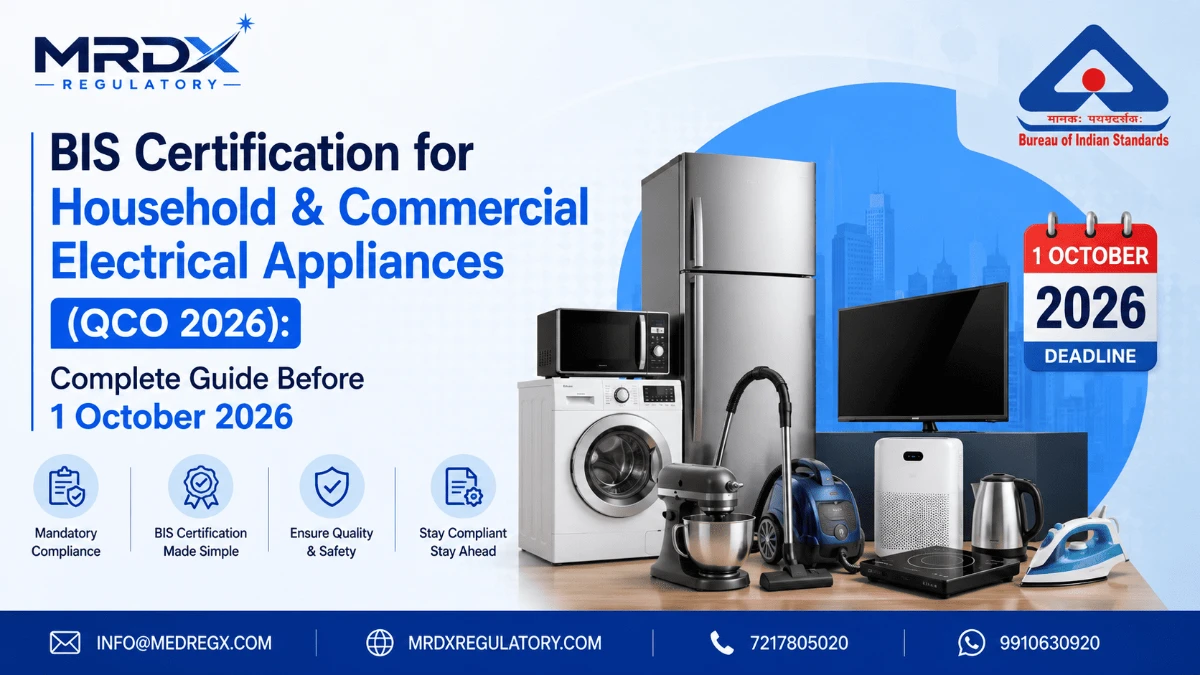
The Bureau of Indian Standards (BIS) — India's national standards body, constituted under the BIS Act, 2016 — has brought more than 90 categories of everyday electrical appliances under mandatory ISI Mark certification through the Safety of Household, Commercial and Similar Electrical Appliances (Quality Control) Order, 2026. Notified by the Ministry of Commerce and Industry's Department for Promotion of Industry and Internal Trade (DPIIT) as S.O. 1739(E) on 6 April 2026, this order supersedes the 2025 version of the same QCO and sets a compliance deadline of 1 October 2026 for general and large manufacturers — a date that is now only weeks away.
For manufacturers, importers, and sellers of kitchen appliances, personal care devices, cleaning equipment, and dozens of other everyday electrical products, this QCO represents one of the broadest BIS enforcement expansions in recent years. This guide explains exactly what's covered, the certification process under IS 302 (Part 1):2024, the phased deadlines by enterprise size, and where manufacturers commonly run into trouble. For related BIS certification requirements, see our guides on BIS consultation covering ISI, CRS, and FMCS certification and BIS ISI Mark certification for tables and desks.
What is the Electrical Appliances QCO 2026, and what does it require?
The Safety of Household, Commercial and Similar Electrical Appliances (Quality Control) Order, 2026 is a mandatory BIS certification requirement covering electrical appliances rated up to 250V (single-phase) or 480V (other systems), including DC-supplied and battery-operated appliances, intended for household, commercial, or similar use. Covered appliances must comply with Indian Standard IS 302 (Part 1):2024 — aligned with the international standard IEC 60335-1:2020 — and bear the BIS Standard Mark (ISI Mark) under a valid licence before they can legally be manufactured, imported, or sold in India.
Certification follows Scheme-I of Schedule II under the BIS (Conformity Assessment) Regulations, 2018 — the same product certification route used for other BIS-regulated goods such as furniture and toys — combining laboratory testing with a factory inspection. The order applies broadly across appliance types rather than to a single product category, which is what makes its scope significantly wider than most individual BIS QCOs issued in recent years.
This isn't BIS's first attempt at regulating this product family — the current 2026 order supersedes an earlier 2025 version, which itself built on prior notifications dating back to 2024. Each revision has expanded scope and refined implementation timelines, reflecting a deliberate, ongoing effort by the government to bring consumer electrical safety in line with international benchmarks like IEC 60335-1 rather than a one-off regulatory event. Manufacturers who complied with the 2025 version of the order should specifically check whether their existing licence and test reports remain valid under the revised 2026 requirements, since a superseding order can carry updated technical or documentation requirements even where the underlying product category is unchanged.
Which electrical appliances are covered under the 2026 QCO?
The 2026 QCO covers more than 90 categories of household, commercial, and similar electrical appliances, spanning kitchen equipment, personal care devices, cleaning appliances, water heating equipment, and battery-operated products. The order does not apply to appliances already regulated under a separate BIS QCO or otherwise notified for mandatory BIS certification under another law, so manufacturers with products spanning multiple categories should confirm which specific order governs each product line.
| Appliance category | Examples |
|---|---|
| Kitchen & cooking appliances | Electric ovens, cooktops, dishwashers, food processors |
| Cleaning appliances | Vacuum cleaners, air cleaners, washing machines |
| Personal care devices | Hair dryers, electric shavers, grooming appliances |
| Water & space heating | Water heaters, electric irons, room heaters |
| Battery-operated & DC appliances | Portable battery-powered household and commercial devices |
This table is illustrative, not exhaustive — the full list of 90-plus covered categories is set out in the official gazette notification (S.O. 1739(E)). Manufacturers should verify their specific product against the notified list rather than relying on a general category match, since two similar-looking appliances can fall under different Indian Standards depending on their exact function and power rating.
The 2026 order (S.O. 1739(E), 6 April 2026) formally supersedes the 2025 version of the same QCO, revising the implementation timeline for different enterprise sizes. With the general manufacturer deadline of 1 October 2026 now only weeks away, BIS-recognised testing laboratories are reporting queue backlogs as manufacturers rush to complete IS 302 (Part 1):2024 testing before the cutoff. If you haven't started the certification process yet and manufacture at scale, this is a hard deadline risk, not a distant compliance item — testing slots booked now may still not clear in time for an October launch.
Compliance deadlines by enterprise size
The 2026 QCO applies a phased deadline structure — general and large enterprises must comply by 1 October 2026, with small and micro enterprises given additional time under the MSMED Act, 2006 definitions.
| Enterprise category | Compliance deadline |
|---|---|
| General / large manufacturers | 1 October 2026 |
| Small enterprises | 1 January 2027 |
| Micro enterprises | 1 April 2027 |
Enterprise size is determined under the Micro, Small and Medium Enterprises Development (MSMED) Act, 2006, based on investment and turnover thresholds — manufacturers should confirm their current Udyam classification rather than assuming eligibility for an extended deadline, since misclassifying enterprise size and missing the correct deadline carries the same consequences as having no certification plan at all.
Documents required for BIS certification of electrical appliances
A complete BIS application under IS 302 (Part 1):2024 needs company documentation, product technical files, and test evidence — incomplete technical files are the most common reason applications stall.
How to get BIS certification for electrical appliances: step-by-step
BIS certification under the 2026 QCO follows Scheme-I and runs through six stages, typically completed within around 90 days for Indian manufacturers.
Are any electrical appliances exempt from this QCO?
Yes — appliances manufactured exclusively for export, products already regulated under a separate BIS QCO, and limited research and development imports of up to 200 units per year are exempt from the 2026 order. The R&D import exemption carries specific conditions: qualifying units generally must be scrapped after use, with records maintained and reported to the relevant government authority rather than sold into the domestic market.
Manufacturers should not assume an exemption applies without checking the specific wording of the order against their exact product and use case — a product that appears to overlap with another QCO's scope, for example, needs that overlap confirmed rather than assumed, since an incorrect exemption claim discovered after the deadline carries the same practical consequences as having no certification at all.
This obligation extends beyond manufacturers to importers, distributors, and e-commerce sellers listing covered appliances — a marketplace seller sourcing an uncertified appliance from an overseas supplier and reselling it in India is not shielded from the requirement simply because it doesn't manufacture the product itself. Large retail chains and e-commerce platforms have also begun requiring proof of a valid BIS licence as a condition of onboarding new appliance listings ahead of the October 2026 deadline, which means non-compliant products risk losing shelf space and marketplace visibility even before any direct regulatory enforcement action takes place.
What does BIS certification for electrical appliances cost?
BIS certification cost for electrical appliances depends on the number of product models, licence and marking fees, and laboratory testing charges — there is no single flat fee that applies across every appliance category. Government licence fees are published by BIS and are usually the smaller component of overall cost; the larger driver is typically laboratory testing, since electrical safety testing under IS 302 (Part 1):2024 covers multiple hazard categories and each distinct model or rating variant generally needs its own test report.
Consultant fees, where used, are usually quoted separately and structured as a flat project fee, a per-model fee, or a broader retainer covering renewal and surveillance support after the licence is granted. Given the compressed timeline before the October 2026 deadline, manufacturers should also budget for potential lab testing premiums or expedited scheduling costs, since demand for BIS-recognised lab slots has increased sharply as the deadline approaches — get a written, itemised quote as early as possible rather than waiting for a lower-cost slot that may not materialise before your compliance date.
Common pitfalls in electrical appliance BIS applications
Most delays under this QCO trace back to a handful of recurring errors — starting the process too close to the October 2026 deadline carries the highest risk, given current lab capacity constraints.
| Pitfall | Impact | Severity |
|---|---|---|
| Starting certification too close to 1 October 2026 | Lab backlogs may prevent completion before the deadline | High |
| Incorrect enterprise-size classification | Wrong deadline assumed; non-compliant sale after true deadline passes | High |
| No Authorised Indian Representative for foreign manufacturers | FMCS application cannot be filed at all | High |
| Testing only one model when multiple ratings are sold | Untested variants remain non-compliant | Medium |
| Factory not audit-ready at inspection | Re-inspection scheduling delay | Medium |
How MRDX REGULATORY supports BIS certification for electrical appliances, end-to-end
MRDX REGULATORY provides BIS ISI certification consulting covering the full IS 302 (Part 1):2024 compliance journey for electrical appliance manufacturers, importers, and sellers — from scope confirmation through to licence issuance and post-certification surveillance. We've also supported certification under other BIS product categories, including toys under IS 9873 and concrete paver blocks under IS 15658:2021, giving us practical experience managing Scheme-I certification across very different product types and manufacturing environments. If you're still comparing consultants before choosing one, our Top 10 BIS-ISI Consultants in India (2026) guide covers what to look for.
The Safety of Household, Commercial and Similar Electrical Appliances (Quality Control) Order, 2026 has turned BIS certification from a category-specific requirement into a near-universal one for electrical appliance manufacturers and importers. With the general deadline of 1 October 2026 now imminent and testing labs filling up fast, the practical window to start certification without risking a compliance gap is closing. Whether you manufacture a single appliance line or a broad portfolio spanning multiple categories, confirming your exact product scope against the notified list, verifying your enterprise-size classification, and beginning testing now is what will keep your products on Indian shelves — and on marketplace listings — past October.
Talk to the MRDX REGULATORY team for a scope review and testing timeline specific to your product range.
Talk to a BIS Expert