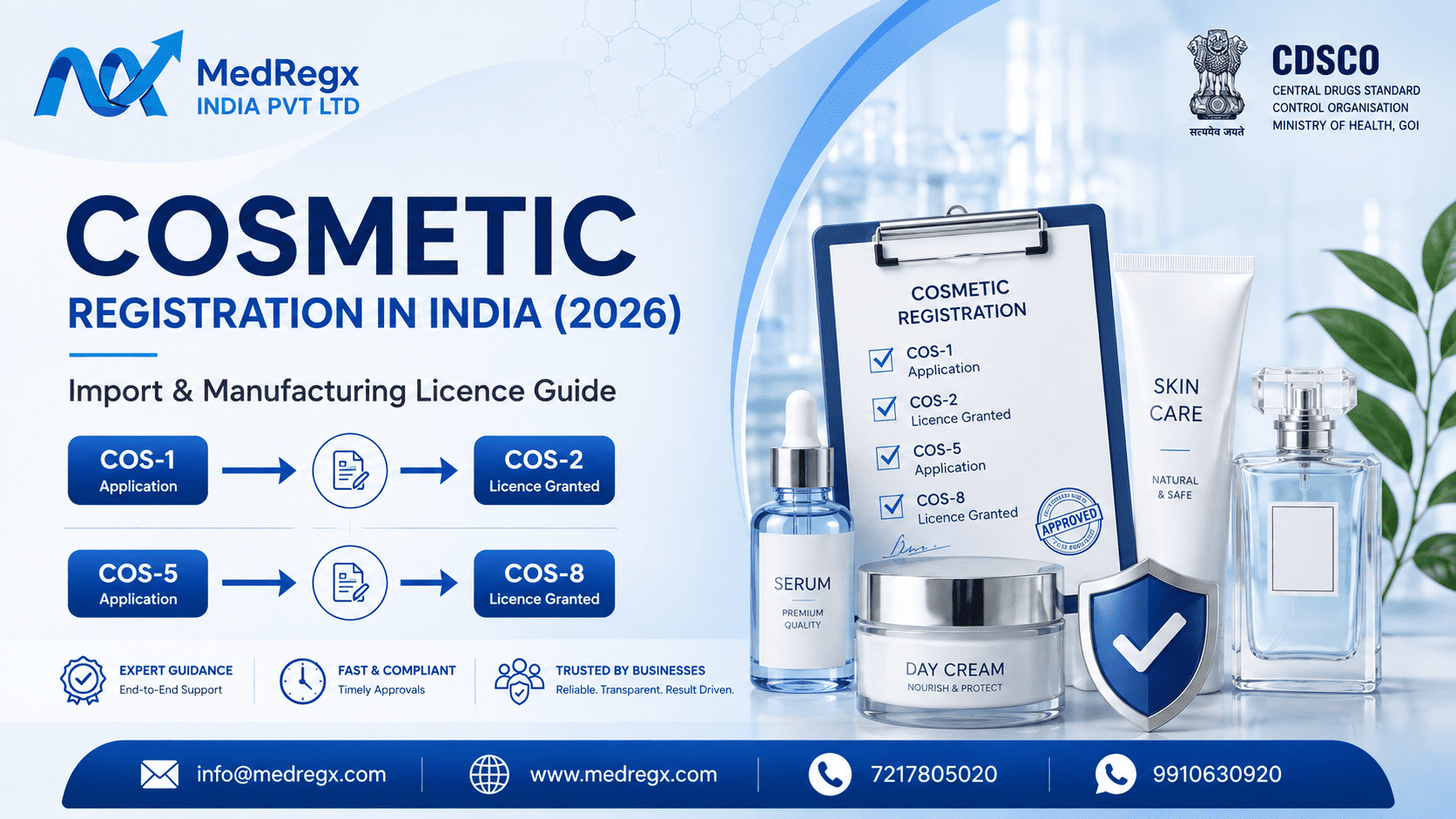
Whether you import an international beauty brand or manufacture skincare in India, one thing is non-negotiable: your cosmetics must be registered before they can be legally sold. Cosmetic registration in India is governed by the Cosmetics Rules, 2020, and the route you take depends entirely on whether you import or manufacture. Get the route wrong — or skip registration — and you risk seizure of stock and prosecution.
Update — August 2026: CDSCO's 23 July 2026 circular has stepped up vigilance on imported cosmetics sold without a valid COS-2 Import Registration Certificate — every brand, variant and shade on sale must be registered. Read the update →
This is the complete overview of cosmetic registration in India: the two routes (import and manufacture), who needs which, the forms, documents, cost, timeline and the mistakes that cause rejections — with links to our in-depth guides where you need more detail.
What "cosmetic registration" actually means in India
In India, "cosmetic registration" is an umbrella term for the legal approval a cosmetic needs before sale. It splits into two clear routes:
- Import route — for finished cosmetics brought into India from abroad. This needs a registration certificate (Form COS-2), granted centrally by CDSCO.
- Manufacturing route — for cosmetics made in India. This needs a manufacturing licence (Form COS-8), granted by the State Licensing Authority.
Everything else — labelling, product-category rules, ingredient restrictions — sits on top of one of these two approvals.
Which route applies to you?
| If you… | You need | Granted by |
|---|---|---|
| Import finished cosmetics from abroad | Import Registration (COS-1 → COS-2) | CDSCO (central) |
| Manufacture cosmetics in India for sale | Manufacturing Licence (COS-5 → COS-8) | State Licensing Authority |
| Get a third party to manufacture for your brand | Loan Licence (COS-7 → COS-8) | State Licensing Authority |
Route 1: Importing cosmetics (COS-1 → COS-2)
To import cosmetics, the importer or the manufacturer's Authorised Indian Agent applies to CDSCO in Form COS-1, and on approval receives the Import Registration Certificate in Form COS-2. The certificate lists the exact brands, categories, variants and shades allowed for import — anything not listed is treated as unregistered.
Core documents include the manufacturer's details, a Free Sale Certificate from the country of origin, product and ingredient information, labels, and the Power of Attorney appointing the Indian agent. For the full step-by-step process, documents and cost, see our detailed guide: CDSCO cosmetic import registration — the complete COS-1 & COS-2 guide.
Route 2: Manufacturing cosmetics in India (COS-5 → COS-8)
If you make cosmetics in India, you apply to your State Licensing Authority in Form COS-5, and on approval receive the manufacturing licence in Form COS-8. Unlike import registration, this route involves a physical inspection of your manufacturing premises.
Typical requirements include:
- A manufacturing premises meeting the Rules' space, hygiene and layout norms.
- A competent technical staff member with the prescribed qualifications.
- Adequate plant, machinery and testing arrangements (in-house or by arrangement).
- Product formulation and specification details for each cosmetic.
- Fees per product category, and a site inspection by the licensing authority.
Brand owners who do not run their own factory can instead use a loan licence to manufacture through a licensed third-party unit.
Labelling — the rule everyone underestimates
Registration is only half the job. Every cosmetic sold in India must carry a compliant label: name of the cosmetic, name and address of the manufacturer/importer, net quantity, batch number, manufacturing and expiry details, list of ingredients where required, and the import registration number for imported products. Non-compliant labels are a common reason for market action even when the product itself is registered. See our label compliance support for details.
Cost and timeline
Costs are driven by government fees (per product/category), documentation, and — for imports — legalised foreign certificates. As a rough guide:
| Route | Typical timeline | Key step |
|---|---|---|
| Import (COS-2) | ~3–6 months | Central CDSCO review |
| Manufacture (COS-6) | Varies by state | Premises inspection |
Common mistakes that delay cosmetic registration
- Choosing the wrong route — treating an import as a manufacturing case or vice versa.
- Incomplete product lists — leaving variants or shades off the COS-1 application, so they end up unregistered.
- Weak Free Sale Certificate or country-of-origin mismatch (imports).
- Premises or technical-staff gaps that fail the state inspection (manufacture).
- Non-compliant labels discovered after the product is already on shelves.
Special cosmetic categories that need extra care
Some products carry additional conditions on top of standard registration, and they are a frequent source of rejections and market action:
- Hair dyes and colours — must carry the prescribed caution and patch-test warning, and may only use permitted colourants within set limits.
- Products making special claims (anti-ageing, anti-dandruff, sunscreen SPF) — claims must be substantiated and must not cross into "drug" territory, which would require a different licence altogether.
- Cosmetics with restricted ingredients — heavy metals such as lead, arsenic and mercury are capped, and certain substances (for example, hexachlorophene) are prohibited or restricted. Formulations must stay within the Rules' limits.
- Children's cosmetics and skin-lightening products — attract closer scrutiny of ingredients and claims.
Confirming that your formulation, claims and labelling comply before you file avoids the most expensive kind of delay — a product recalled from the market after launch.
After registration: validity, renewals and changes
Registration is not a one-time event. A few things to plan for:
- Validity — an import registration certificate (COS-2) remains valid as long as it is not suspended or cancelled, subject to the conditions of the Rules; keep your records and fees in order.
- New products and variants — adding a brand, category, variant or shade generally requires updating or extending your registration before those SKUs can be sold.
- Post-approval changes — changes to the manufacturer, formulation or label may need to be notified or approved.
- Manufacturing licence upkeep — COS-8 licences must be maintained in line with inspection conditions and renewed as required by the State Authority.
Treating your registration as a living record — reconciled against your actual catalogue every few months — is the simplest way to stay on the right side of enforcement, especially given the current vigilance on unregistered imported cosmetics.
How MedRegX handles cosmetic registration end-to-end
MedRegX manages both routes: import registration (COS-1 → COS-2) as or alongside your Authorised Indian Agent, and manufacturing licences (COS-5 → COS-8, or loan licences) including premises and documentation readiness. We reconcile your full product catalogue against your registration, handle labelling, and close every query until you are cleared to sell. Explore our cosmetic registration and cosmetic import services.
Cosmetic registration support across India
We support brands, importers and manufacturers nationwide — Delhi NCR, Mumbai, Bengaluru, Hyderabad, Chennai, Ahmedabad and Pune — across both the central (import) and state (manufacturing) routes.
Frequently asked questions
What is cosmetic registration in India?
It is the approval required under the Cosmetics Rules, 2020 before a cosmetic can be legally imported or manufactured for sale in India. Imported cosmetics need a registration certificate (Form COS-2, applied for via Form COS-1); domestic manufacturers need a manufacturing licence (Form COS-8, applied for via Form COS-5).
Is cosmetic registration mandatory in India?
Yes. No cosmetic may be imported without a valid COS-2 registration certificate, and no cosmetic may be manufactured for sale without a COS-8 manufacturing licence. Selling unregistered cosmetics can lead to seizure and prosecution under the Drugs and Cosmetics Act, 1940.
Who issues cosmetic registration in India?
Import registration (COS-2) is granted centrally by CDSCO. Manufacturing licences (COS-8) are granted by the State Licensing Authority of the state where the manufacturing unit is located.
What is the difference between importing and manufacturing cosmetics?
If you bring finished cosmetics into India from abroad, you need import registration (COS-1 to COS-2). If you make cosmetics in India, you need a manufacturing licence (COS-5 to COS-8). Brand owners who import and then relabel still fall under the import route.
How long does cosmetic registration take?
Import registration (COS-2) typically takes around 3 to 6 months depending on documentation and CDSCO queries. A manufacturing licence (COS-8) timeline depends on the State Licensing Authority and includes a plant inspection.
Ready to register your cosmetics in India?
Tell us whether you import or manufacture, and MedRegX will map the exact route, documents, cost and timeline for your products.
Get a Free Consultation