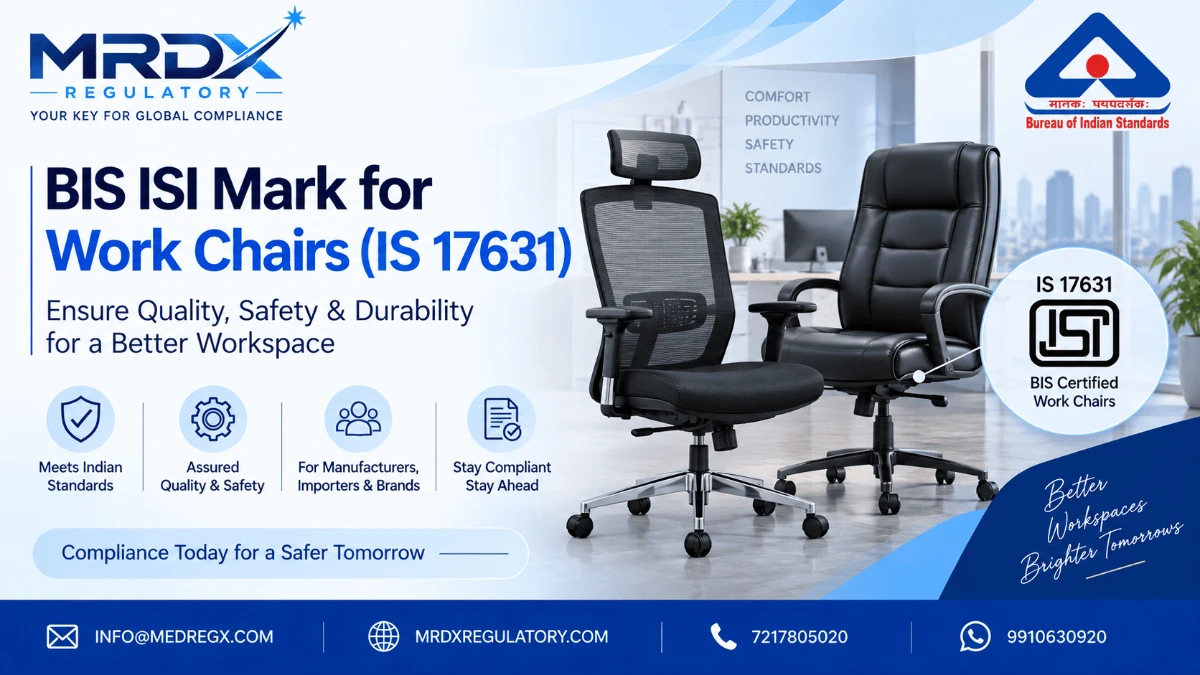
The Bureau of Indian Standards (BIS) — India's national standards body, constituted under the BIS Act, 2016 — requires mandatory ISI Mark certification for work chairs under the Furniture (Quality Control) Order, 2025. Work chairs — office, task, executive, and other seating fitted with swivel mechanisms, castors, or height-adjustment systems — must conform to Indian Standard IS 17631:2022, and the order came into force for medium and large enterprises on 14 February 2026.
This is the same Furniture QCO family that brought BIS ISI Mark certification for tables and desks under IS 17633:2022 into force, and manufacturers producing both product lines will need a separate BIS licence for each. If you're new to how the underlying BIS certification schemes fit together, our BIS consultation guide covering ISI, CRS, and FMCS certification explains the framework. This article focuses specifically on what IS 17631:2022 requires for work chairs, the certification process, current 2026 deadlines, and where manufacturers most often go wrong.
What is the BIS ISI Mark for work chairs under IS 17631:2022?
The BIS ISI Mark for work chairs is a mandatory conformity certification confirming that an office or task chair meets the strength, stability, and durability requirements set out in Indian Standard IS 17631:2022. Without it, a covered work chair cannot legally be manufactured, imported, or sold in India. IS 17631:2022 specifically covers chairs designed for use at a workstation — including ergonomic, revolving, executive, task, and operator chairs — that are fitted with a swivel mechanism, a castor or wheeled base, height adjustment, or tilting/reclining functions.
This is an important distinction: a separate standard, IS 17632:2022, covers general-purpose chairs and stools — simple fixed seating without swivel mechanisms or castors — and explicitly excludes any chair covered by IS 17631:2022. Manufacturers sometimes assume these two standards are interchangeable or confuse which one applies to their product; getting this wrong means testing against the wrong standard entirely, which BIS will not accept as valid evidence for a work chair licence. If your chair swivels, rolls, reclines, or has height adjustment, IS 17631:2022 is the applicable standard, not IS 17632:2022.
Who needs BIS certification for work chairs in India?
Any domestic manufacturer, importer, or seller placing work chairs covered by the Furniture (Quality Control) Order, 2025 on the Indian market needs a valid BIS licence under IS 17631:2022, once the applicable compliance deadline has passed. Medium and large enterprises have been required to comply since 14 February 2026; Udyam-registered Micro and Small Enterprises (MSEs) received an 18-month extension from the order's publication date, pushing their deadline to 13 August 2026 — a timeline extension only, not a permanent exemption.
Work chairs manufactured exclusively for export are exempt, and the Furniture (Quality Control) Amendment Order, 2026 added transitional relief for consignments already in transit — a Bill of Lading dated before 14 February 2026 keeps a shipment exempt provided the Bill of Entry is filed within 180 days. Institutional buyers — corporate offices, co-working operators, and government procurement teams furnishing workstations at scale — have also started requiring proof of a valid BIS licence before onboarding a chair supplier, which means non-compliant work chairs can lose access to large institutional orders well before any direct regulatory enforcement action.
This obligation applies just as much to online furniture retailers and B2B office-supply distributors as it does to manufacturers — a distributor sourcing work chairs from an uncertified overseas supplier and reselling them domestically remains bound by the order even though it manufactures nothing itself. Manufacturers producing work chairs under a private-label or white-label arrangement for a distributor should also clarify in their commercial contracts which party holds the BIS licence, since certification is tied to the licence holder, not simply to whoever physically assembles the product.
The Furniture (Quality Control) Amendment Order, 2026 (S.O. 774(E), 13 February 2026) inserted new provisos into the original 2025 order covering pre-implementation stock, R&D imports, and export-only imports, and confirmed the transitional Bill of Lading exemption described above. A separate amendment (S.O. 777(E), 12 February 2026) clarified Udyam eligibility conditions for the MSE deadline extension. Work chair manufacturers and importers with shipments already in transit should verify which proviso applies to their specific consignment rather than assuming automatic exemption.
What does IS 17631:2022 actually test for?
IS 17631:2022 tests work chairs for structural strength, stability, and the durability of moving components — swivel mechanisms, castors, height-adjustment systems, and tilt/recline functions — under repeated use. Swivel testing confirms the seat rotates smoothly without excessive play or mechanical failure over repeated cycles, while castor and base durability testing evaluates whether the wheeled base withstands repeated rolling loads without cracking or losing structural integrity.
Control unit testing — covering gas-lift height adjustment, tilt-tension mechanisms, and locking systems — is typically conducted on a batch basis, since these mechanical components are more prone to variation across a production run than the chair's frame or upholstery. Stability testing confirms the chair doesn't tip over under a defined lateral force applied at the backrest or armrest, which matters particularly for chairs with a narrow five-point base or an extended reclining range. Testing also checks for sharp edges, unsafe projections, and exposed fasteners around the seat, backrest, and armrests, since these are common injury points in office seating that sees continuous daily use.
Documents required for BIS ISI Mark certification (work chairs)
A complete BIS application for work chairs needs company documentation, product technical details, and test evidence against IS 17631:2022 — incomplete mechanism documentation is the most common reason applications stall.
How to get BIS ISI Mark certification for work chairs: step-by-step
BIS ISI Mark certification for work chairs follows Scheme-I of Schedule II under the BIS (Conformity Assessment) Regulations, 2018, and runs through six stages from application to licence grant.
How do foreign work chair manufacturers get BIS certification?
Foreign manufacturers exporting work chairs to India must certify under the Foreign Manufacturers Certification Scheme (FMCS) and appoint an Authorised Indian Representative (AIR) before an application can be filed. The AIR holds the licence on the manufacturer's behalf, manages BIS correspondence, and typically coordinates the factory inspection at the overseas manufacturing site. Our BIS FMCS certification service covers this end-to-end for manufacturers exporting furniture, electronics, and other BIS-regulated products into India.
The standard FMCS timeline runs to roughly 180 days — considerably longer than the 30-to-45-day domestic timeline — so exporters bringing new work chair ranges into India should start well ahead of any applicable deadline. Manufacturers working with a local team on the ground, including our FMCS consultant team in Noida, often find AIR coordination and factory-inspection scheduling considerably smoother than managing it remotely.
What does BIS certification for work chairs cost?
BIS certification cost for work chairs depends on the number of product variants, mechanism types, applicable licence and marking fees, and laboratory testing charges — there is no single flat fee across every manufacturer. Government licence fees are published by BIS and are typically the smaller component of overall cost; the larger driver is usually laboratory testing, since each distinct chair model — particularly where the base, control unit, or upholstery differs — generally needs its own test report against IS 17631:2022.
Consultant fees, where used, are typically quoted separately and can be structured as a flat project fee, a per-model fee, or a broader retainer covering renewal and surveillance support after the licence is granted. Because cost depends heavily on how many chair models and mechanism variants a manufacturer sells, the only reliable way to budget accurately is a written, itemised quote after a consultant has reviewed your specific product range.
It's also worth budgeting for the cost of retesting if a control unit or castor design fails during initial evaluation — mechanical components under IS 17631:2022 tend to reveal issues under cyclic testing that aren't obvious from a short hands-on inspection, and a failed batch test typically means sourcing a revised component and resubmitting a sample rather than a quick fix. Manufacturers who validate mechanism durability internally before formal BIS testing begins generally avoid this added cost and the timeline slippage that comes with it.
Common pitfalls in BIS applications for work chairs
Most delays in BIS work chair applications trace back to a handful of recurring errors — testing against the wrong standard carries the highest risk, since it invalidates the entire test report.
| Pitfall | Impact | Severity |
|---|---|---|
| Testing under IS 17632:2022 instead of IS 17631:2022 | Test report invalid; product must be retested against the correct standard | High |
| Missing the 14 Feb / 13 Aug 2026 compliance deadline | Product cannot legally be manufactured, imported, or sold | High |
| No Authorised Indian Representative for foreign manufacturers | FMCS application cannot be filed at all | High |
| Testing only one control unit/base when multiple are sold | Untested variants remain non-compliant; query raised by BIS | Medium |
| Factory not audit-ready at inspection | Re-inspection scheduling delay | Medium |
How MRDX REGULATORY supports BIS certification for work chairs, end-to-end
MRDX REGULATORY provides BIS ISI certification consulting covering the full IS 17631:2022 compliance journey for work chair manufacturers, importers, and sellers — from correct standard identification through to licence issuance and post-certification surveillance. We've also supported certification across the wider Furniture QCO family, including tables and desks under IS 17633:2022, and other BIS-regulated categories such as the recently notified household and commercial electrical appliances QCO. If you're comparing consultants before choosing one, our Top 10 BIS-ISI Consultants in India (2026) guide covers what to look for.
The Furniture (Quality Control) Order, 2025 has made BIS certification for work chairs a mandatory market-access requirement, not a voluntary quality marker, and the compliance window is active now for most manufacturers and closing fast for MSEs. Whether you manufacture office seating domestically, import work chairs, or supply institutional buyers at scale, confirming your product falls under IS 17631:2022 — and not the general-purpose chairs standard — and starting certification well ahead of your applicable deadline is what will keep your products moving through Indian supply chains without interruption.
Talk to the MRDX REGULATORY team for a scope review and documentation checklist specific to your work chair range.
Talk to a BIS Expert